Music of Hawaii
Did you know that the Hawaiian language doesn’t actually have a word for music? Despite this fact, the music culture in Hawaii is very rich! Similarly to the cultures of Native Americas and Middle East, chanting or mele is a big part of Hawaiian culture. Even though the Hawaiian language doesn’t have a word for music, mele acts as the foundation for all Hawaiian music. Mele was often done alongside hula dancing as a form of expression, to praise the Gods, and as a form of storytelling. The Hawaiian people would also play lots of instruments to accompany the song, dance and mele. In the 1700s Europeans came to Hawaii and brought their music with them. When the Europeans came, they exposed the Hawaiians to Christian hymns. Shortly after the Europeans came and brought guitars and cavaquinhos which eventually the Hawaiians adapted into the beloved ukulele.
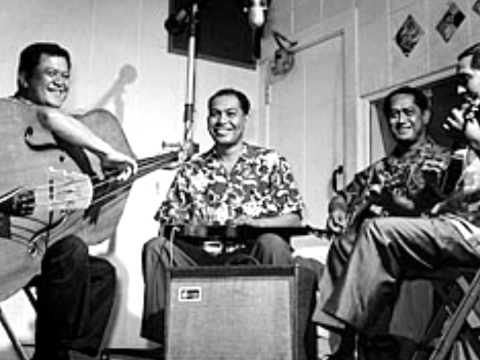
Another way that the guitar/cavaquinhos was adapted was by loosening the strings of the guitar. Loosening the strings of the guitar gave the instrument a distinct sound and made finger-picking easier. This way of playing guitar became known as “slack-key guitar” and became very popular. (I've attached a video of a Gabby Pahinui song. He's a very popular Hawaiian musician and played slack-key guitar)
Instruments of Hawaii
Ipu
 |
| Ipu heke |
Ipu drums are made of hollowed out Gourds. Ipu drums can either be single gourd drums (ipu) or double gourd drums (ipu heke). Ipu drums are smaller and more portable which means it’s easier for hula dancers to dance with them. The ipu heke drums are larger but still pretty portable. While I was researching the Ipu drums, I found a video about how the Ipe is made. When picking an Ipu drum, picking your gourd is important because you will be one with your Ipu. In order to make an Ipur drum, you first inspect the gourd and make sure there’s no cracks in it. After that, you wash the gourd and scrub all the dirt off of the exterior. While everyone was cleaning their gourd, the person facilitating the ipu building said that cleaning the gourds was “a good time to connect and bond with your ipu”. Once the gourds were clean, everyone then cut the neck of the gourd and hollowed out the inside to create a hole. After you’ve cut your first gourd, if you’re making an ipu heke then you cut the neck of your second gourd, put it on top, and cut the resonant hole in the top. Now that you have prepared both gourds, you can sand it down to make it smooth then glue them together. Boom! Now you have an Ipu heke! If you want to watch the video I learned this information from, I’ve included it below. I have also attached some videos so that you can see the ipu heke in action.
Uli' Uli'
 |
| Uli' Uli' |
Another gourd instrument is the uli' uli'. The uli' uli' is the Hawaiian shaker. The uli' uli 'can be filled with seeds, pebbles, or beads. Typically, the uli' uli' are decorated with feathers.
Ili' Ili'
Ili ili are two river stones that you hold in your hands. One of the river stones is held by your thumb and index finger and the other is held in your hand. When you open and close your hands, a clacking sound is made.
Pu'ili

Hawaiian Dance
Now that you know a little bit about the history of Hawaiian music and about some of their instruments, Let's look at some forms of Hawaiian dance!
Fire Knife Dancing

When the Polynesians came and settled in Hawaii, they brought a lot of their traditions with them. One of these traditions is fire knife dancing. It’s believed that fire knife dancing was originally used as a way to prepare men for war. The fire knife dances were kind of a way to get their adrenaline going before they left for battle. The knives are wrapped in towels so that they can catch flame and then the dancers perform dance and tricks with the fire knife. Check out this video below and see what you think! The beginning of the video shows how they’re lighting the fire and then they go into the dance.
Hula Dance

Perhaps the most popular form of Hawaiian dance is Hula Dance. Hula dance is a form of storytelling that is accompanied by Hawaiian music or mele. Most of the time, hula is performed by women, but it can be performed by men too. While hula is often performed as a form of entertainment for tourists, hula is actually very sacred and is often performed at religious ceremonies. It isn’t uncommon for hula dancing to be done in church. Another way that hula is used is as a ritual to promote abundance/fertility in Hawaii's land, community, and people. Hula is a very important part of Hawaiian culture because it helps tell their story and preserve their history. Below I have attached two videos. The first video is of the hula dance. The second is a beautiful video by National Geographic about the history of hula. I hope you enjoy them!
Queen Lil'uokalani

For my last section about Hawaiian culture and music, I would like to talk about Queen Lili’uokalani. Lili’uokalani was the last monarch in Hawaii before the United States claimed Hawaii as US territory in July of 1898. While there are a lot of Hawaiian politics I could discuss here, the reason I wanted to talk about Queen Lili’uokalani is because of all the music she wrote
Queen Lili’uokalani had a good education and musical background. Lili'uokalani could play and she was a trained singer and choir director. In the course of her lifetime, Queen Lili’uokalani composed/wrote over 150 mele. One of her first works was a song titled “He Mele Lahui Hawaii” which translates to “Song of The Hawaiian Nation”. I’ve attached the song and an English translation below.
Almighty Father bend thine ear
And listen to a nation's prayer
That lowly bows before thy throne
And seeks thy fostering care
Grant your peace throughout the land
Over these sunny sea girt isles
Keep the nation's life, oh Lord,
And on our sovereign smile
Chorus:
Grant your peace throughout the land
Over these sunny isles
Keep the nations life, oh Lord
And upon our sovereign smile
Guard him with your tender care
Give him length of years to reign
On the throne his father's won
Bless the nation once again
Give the king your loving grace
And with wisdom from on high
Prosperous lead his people on
As beneath your watchful eye
Grant your peace throughout the land
Bless O Lord our country's chiefs
Grant them wisdom so to live
That our people may be saved
And to You the glory give
Watch over us day by day
King and people with your love
For our hope is all in You
Bless us, You who reign above
Grant your peace throughout the land
Believe it or not, you’ve actually probably heard one of Queen Lili’uokalani’s songs! If you’re anything like me, you love the Disney Movie Lilo and Stitch. While there is much more to the Hawaiian culture than is expressed in this movie, there are a few songs in the movie that are known and loved by the Hawaiian people. One of those songs is “Aloha Oe”.
Now that you've had a refresher, let's listen to the whole song!
Conclusion:
Sources
Alexander, K. L. (n.d.). Biography: Queen lili'uokalani. Retrieved January 27, 2022, from https://www.womenshistory.org/education-resources/biographies/queen-liliuokalani
Andy Beal March 30, Beal, A., Andy Beal Andy Beal provides the photos, (Adsbygoogle=Window.adsbygoogle||[]).push({}); Says:, H., says:, L. G. G. T., Says:, F. T., says:, R. S., 29, A. B. says: D., says:, A. B., *, N., & Beal, S. (2019, March 30). The Hawaiian Hula Dance: 10 facts you may not already know. Go Visit Hawaii. Retrieved January 27, 2022, from https://www.govisithawaii.com/2013/05/21/hawaiian-hula-dance/#:~:text=The%20hula%20dance%20is%20one%20of%20Hawaii%E2%80%99s%20oldest,portray%20the%20story%20of%20the%20chant%20or%20song.
Discover Hawaii. (2017, July 7). Hawaiian fire dancers, a spectacle like no other - big island. Discover Hawaii. Retrieved January 27, 2022, from https://www.discover-hawaii.com/big%20island/articles/hawaiian-fire-dancers-a-spectacle-like-no-other_662/
Manual, A. (2020, October 14). Hawaiian music, its origins and evolution. HomeyHawaii. Retrieved January 27, 2022, from https://www.homeyhawaii.com/blog/music/hawaiian-music-origins-and-evolution/
Mele Lāhui Hawaiʻi, Hawaiian National Anthem - Words & music by Queen Liliʻuokalani. Mele Lahui hawaii. (n.d.). Retrieved January 27, 2022, from http://www.huapala.org/Me/Mele_Lahui_Hawaii.html
Milles, K. M. (n.d.). The history of Hawaiian Music. Hawaiian Culture Stories. Retrieved January 27, 2022, from https://www.hawaiian-culture-stories.com/hawaiian-music.html
Riggle, E. (2021, May 26). The songs of Lili'uokalani, queen of hawai'i. All Classical Portland. Retrieved January 27, 2022, from https://www.allclassical.org/the-songs-of-liliuokalani-queen-of-hawaii/
What is hula: Telling the stories of Hawaii. Mana Artisan Botanics. (2021, February 2). Retrieved January 27, 2022, from https://manabotanics.com/hawaiian-culture/hula-stories-of-hawaii/



I am glad that you chose to discuss Hawaiian music, because I have always wondered how their music came to be. I thought it was pretty cool that they do not have a word for music in their language. The history of Hawaiian music is so interesting. I found the ipu drums very interesting and cool. Thank you for sharing!
ReplyDeleteI have always known somewhat about the culture of Hawaii just by hearing about it over the years, but I had never researched their musical history. I love that you included Lilo and Stitch, growing up that was one of my favorites to watch. I am always interested in other forms of dance, which makes sense because of my background, but what really makes me curious is how they choose the songs that they consider songs for dance. I also liked the instruments, they were very cool.
ReplyDeleteThis was an awesome topic, Michaela! All the instruments like the Ipu and the Pu'ili were really cool to learn about. It's funny, I've heard so much Hawaiian music in my life but I've never even as much as seen those instruments. I was also unaware how religious hula dancing is. It gives it a lot more meaning when watching now. Also I love Lilo and Stitch :) great job!
ReplyDeleteMichaela, I loved reading your blog! In the first video, please tell me why that man is playing a double bass sideways. It just hurts to look at. Anyways, I liked all the instruments you included, especially the river rocks. My favorite part was the fire knife dancing, which I’ve always loved since I was a kid. Thanks for sharing!
ReplyDeleteWow Micheala you did phenomenal on this blog . The way the guy is playing a double bass side ways made me laugh lol. But it shows how different cultures do different things. For all I know he may look at US weird for playing a bass right side up !
ReplyDeleteWow! This was really cool to read especially because it brought back some of my memories of when I went to Hawaii when I was little. The fire knife dancing was really cool and even though I thought it was touristy when I was there ive realized that it was more than that. A part of there culture instead. Thanks!
ReplyDelete